AT A GLANCE
- The tournament is scheduled for June 17–July 11, 2027, with the official draw on April 8.
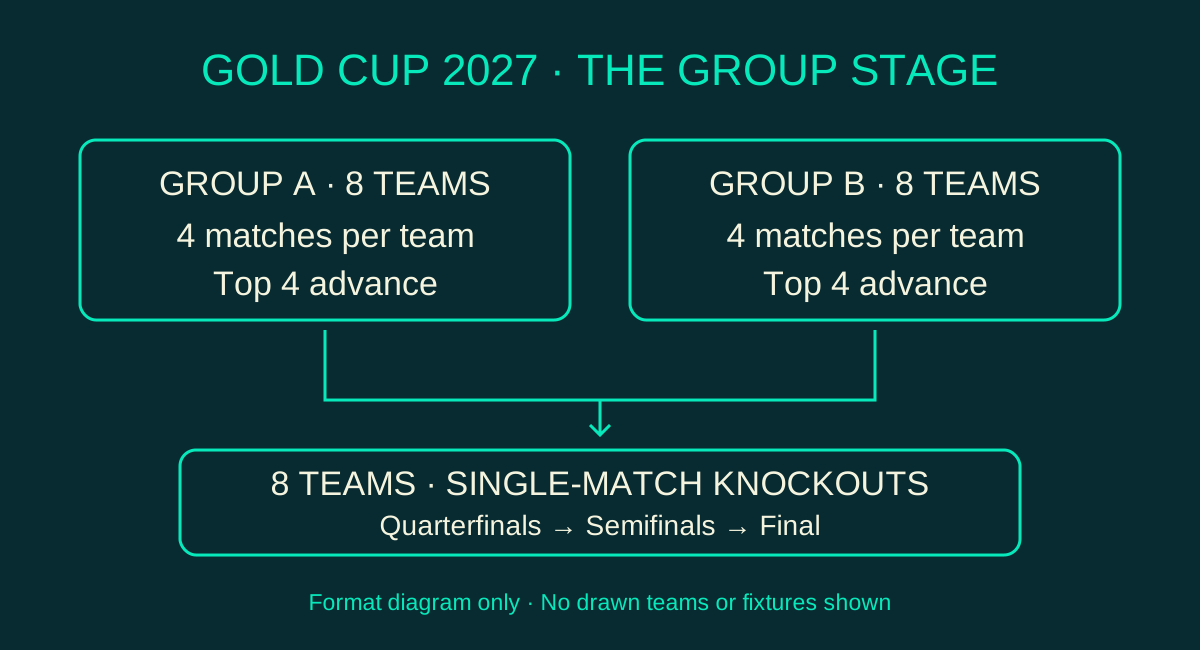
- Sixteen teams will enter two groups of eight; each team plays four different opponents, rather than every other team in its group.
- The top four in each shared group table qualify for single-match quarterfinals, semifinals and the final.
The Gold Cup 2027 format will have two groups of eight teams, with four group matches per team. That is the central change in Concacaf’s November 5 announcement. The field stays at 16 national teams; the competition runs from June 17 to July 11, 2027. Bigger groups do not mean that each side plays seven opponents.
The useful way to follow the new system is to separate three questions: which group a team joins, which four opponents it faces, and where it finishes in the group table. Those are connected decisions, but they are not interchangeable. A shared table can include teams with different fixture lists.
Four opponents, not a complete round robin
AS’s explanation confirms that the draw will use eight ranking-based pots of two teams, placing one team from each pot in each group. Within a group, teams are arranged into four ranking bands. Each team faces one opponent from each band, with the particular fixtures set by a predetermined matrix.
Think of an eight-team group as a pool of seven possible opponents for any one side. The announced schedule selects four of those opponents. Three are not on that team’s group-stage schedule, even though their results still appear in the same standings. This is why reading the table alone will not tell you the full set of matches a team has played.
The ranking bands are a way to structure the range of opponents. They do not establish that every fixture is equally difficult in practice, or predict how teams will perform next summer.
Why the group stage grows from 24 to 32 games
ESPN’s report puts the new group-stage total at 32 matches, compared with 24 under the previous format. The arithmetic helps explain the change: 16 teams playing four times creates 64 team appearances. Each match uses two appearances, so 64 divided by two is 32 games.
Using the former three-match schedule in the same calculation gives 16 times three divided by two, or 24. The increase is therefore eight group games, not a doubling of the tournament. Group size and match count are different measurements: putting more teams into each table does not require every possible pairing to take place.
Eight teams still reach the knockouts
Concacaf says the top four teams in each group advance. The remaining competition consists of single-match quarterfinals, semifinals and the final. Group-stage performance determines the quarterfinal matchups, with higher finishers facing lower finishers.
Four qualifiers from each of two groups produces eight quarterfinalists. That gives fans a straightforward checkpoint: follow the top-four boundary in the relevant table, then the knockout bracket. Qualification is based on finishing position, rather than a claim here that a particular points total will always be sufficient.
Dates are confirmed; venues and tickets come later
ESPN lists the group stage for June 17–30, quarterfinals for July 3–4, semifinals for July 7–8 and the final for July 11. The official draw is scheduled for April 8, 2027. These are tournament-stage dates, not a complete team-by-team itinerary.
Concacaf’s announcement leaves the detailed match schedule, host venues and ticketing for later publication. Until those are issued, the new format explains how the tournament works without establishing where a particular team will play or what entry will cost. Check the official competition updates before making venue-specific plans.
FOLLOW THE TRAIL
Sources & further reading
- Concacaf — new 2027 format and dates ↗
Primary November 5 announcement of group structure, progression, dates and information still to come.
- ESPN México — new group format explained ↗
November 5 report corroborating four matches per team, 32 group games and stage dates.
- AS USA — ranking bands and fixture matrix ↗
November 5 explanation of the pots, ranking bands and incomplete group schedule.
Prepared with AI assistance from Concacaf, ESPN México and AS USA pages read November 6, 2026. The match-count calculations are our explanation of the announced format, not a prediction. No interviews or independent tournament testing were conducted. Artwork is an original diagram. Read our editorial policy.
Last updated . Suggest a correction ↗