AT A GLANCE
- The total solar eclipse is on August 2, 2027; it is a future event, not a newly discovered one.
- The catalog’s 6-minute-23-second central duration is not the viewing time at every location.
- Partial phases require proper solar viewing protection; ordinary sunglasses are unsuitable.
The French search term éclipse solaire appeared in our latest Google Trends sample, with headlines looking ahead to August 2, 2027. The 2027 eclipse catalog lists a total solar eclipse on that date with a central duration of six minutes and 23 seconds. That striking number needs context: it does not describe an equal stretch of darkness for everyone who can see some part of the eclipse.
Where will the eclipse be total?
The future-eclipse overview places total visibility in parts of southern Spain, North Africa and the Middle East, including Egypt and Saudi Arabia. A wider area will see only a partial eclipse. A country appearing in a visibility summary does not mean every town inside its borders experiences totality.
Before selecting a viewing location, check a detailed path map and predictions for that exact place. Keep three questions separate: is an eclipse visible there, is it total there, and how long does the total phase last there? A broad regional headline answers none of those questions precisely enough for an itinerary.
What does the duration figure describe?
The catalog entry gives its central-duration figure alongside a greatest-eclipse location near 25.5 degrees north and 33.2 degrees east. It also distinguishes Universal Time from a local clock. Use those catalog values as an overview of the event, rather than treating one time or duration as a timetable for every observer.
For a local plan, record the beginning and end of totality separately from the longer partial phases. Also distinguish an astronomical prediction from a clear-sky promise. The geometry can be calculated in advance; the weather at your chosen spot remains a separate practical question. This guide does not claim the event is the longest eclipse of the century.
Make viewing safety part of the plan
The solar-viewing guidance requires specialized eye protection whenever any bright part of the Sun is visible. Ordinary sunglasses are not suitable. Direct viewing during partial phases requires proper eclipse glasses or a safe handheld solar viewer; an indirectly projected image is another option.
The only exception for unaided viewing is the brief total phase, when the Moon completely covers the Sun’s bright face at a location inside the path of totality. Protection must go back on as soon as any bright Sun reappears. A partial-eclipse location never has that exception.
The same guidance warns against looking through binoculars, telescopes or camera optics while wearing eclipse glasses. Those instruments need suitable solar filters secured at the front of the optics. Seek expert advice before using such equipment; do not improvise from a photograph of someone else’s setup.
An older photograph, clearly identified
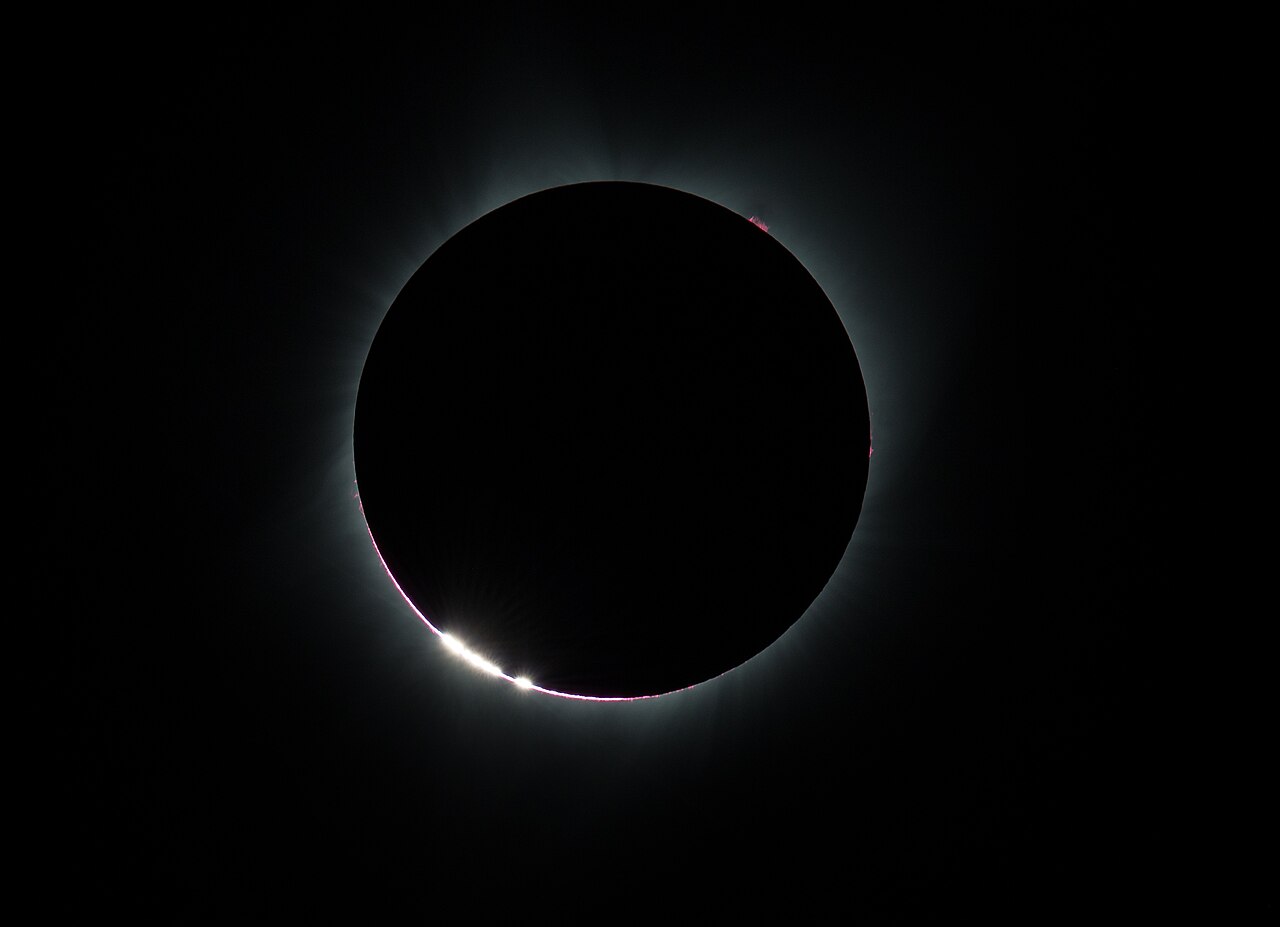
The image above records the 2017 eclipse in Oregon, not the future event. 2017 Total Solar Eclipse, NHQ201708210101 is credited to NASA/Aubrey Gemignani. It is identified as US public-domain NASA work and reused editorially under the media guidelines. The resized photograph has no further pixel edits; the page may crop its display. No NASA endorsement or review of this article is implied.
FOLLOW THE TRAIL
Sources & further reading
- NASA Eclipse Web Site — Eclipses During 2027 ↗
Primary catalog predictions, central duration, location and time-system explanation.
- NASA Science — Future Eclipses ↗
Upcoming eclipse date and broad total-versus-partial visibility regions.
- NASA Science — Eclipse Viewing Safety ↗
Solar viewer requirements, totality exception and optical-equipment filtering precautions.
Prepared with AI assistance and reviewed against the linked primary eclipse references. This is an independently written NowTelli explanation, not a NASA-reviewed product. No site visit, weather forecast, equipment testing or guaranteed viewing conditions are claimed. The photograph depicts the 2017 event. Read our editorial policy.
Last updated . Suggest a correction ↗