AT A GLANCE
- Halloween fireballs is a seasonal nickname for bright Taurid meteors, not a promise of a meteor storm on October 31.
- Both calendars read for this guide place the Northern Taurid maximum around November 12; Southern Taurid dates differ between them.
- A dark, clear sky and patience matter more than binoculars or a telescope for casual meteor watching.
Halloween fireballs is a nickname for the bright meteors associated with the Taurid showers around late October and early November. The Royal Observatory Greenwich guide explains the seasonal nickname and describes a long-lasting shower with relatively sparse activity. A dramatic name can suggest a scheduled spectacle; the useful expectation is a patient watch for an occasional meteor, rather than a sky full of them at an appointed hour.
Why are there two Taurid showers?
Greenwich connects the Taurids with debris from Comet Encke and explains that a dispersed stream takes Earth a long time to cross. The Northern and Southern branches have overlapping activity periods. Their apparent paths lead back toward Taurus, which gives the showers their name.
An active period and a maximum describe different things. A shower can contribute meteors outside its most active date, while a maximum still does not guarantee a sighting during one short visit outside. Brightness and frequency should also be kept separate: a chance of a striking meteor is not the same as a high number of meteors.
Which 2026 dates are supported?
The American Meteor Society's current calendar lists Northern Taurid activity from October 20 to December 10 and a peak night of November 11–12. Greenwich gives November 12 as the Northern maximum. These descriptions point to the same general observing window, rather than a universally visible instant.
The Southern entries are less consistent. AMS distinguishes an October 14 annual component from a November 5 fireball-swarm component, showing November 4–5 as its peak night. Greenwich instead lists October 10 as its Southern maximum. This guide does not resolve that difference by silently choosing one date, or interpret a calendar component label as proof that an unusual outburst will occur in 2026.
How should you plan a watch?
Greenwich recommends an unobstructed view, clear conditions and little light pollution. It says binoculars and telescopes offer no advantage for this purpose: your unaided eyes take in more sky. Give your eyes time to adapt, avoid direct lights and make yourself comfortable while waiting.
For readers outside Britain, keep the distinction between general technique and local conditions. A calendar cannot establish the weather at your observing spot, your horizon or a useful local start time. Check those details before travelling. A short, flexible outing close to home may be more practical than a long journey based only on the word fireballs.
What can a photograph tell you?
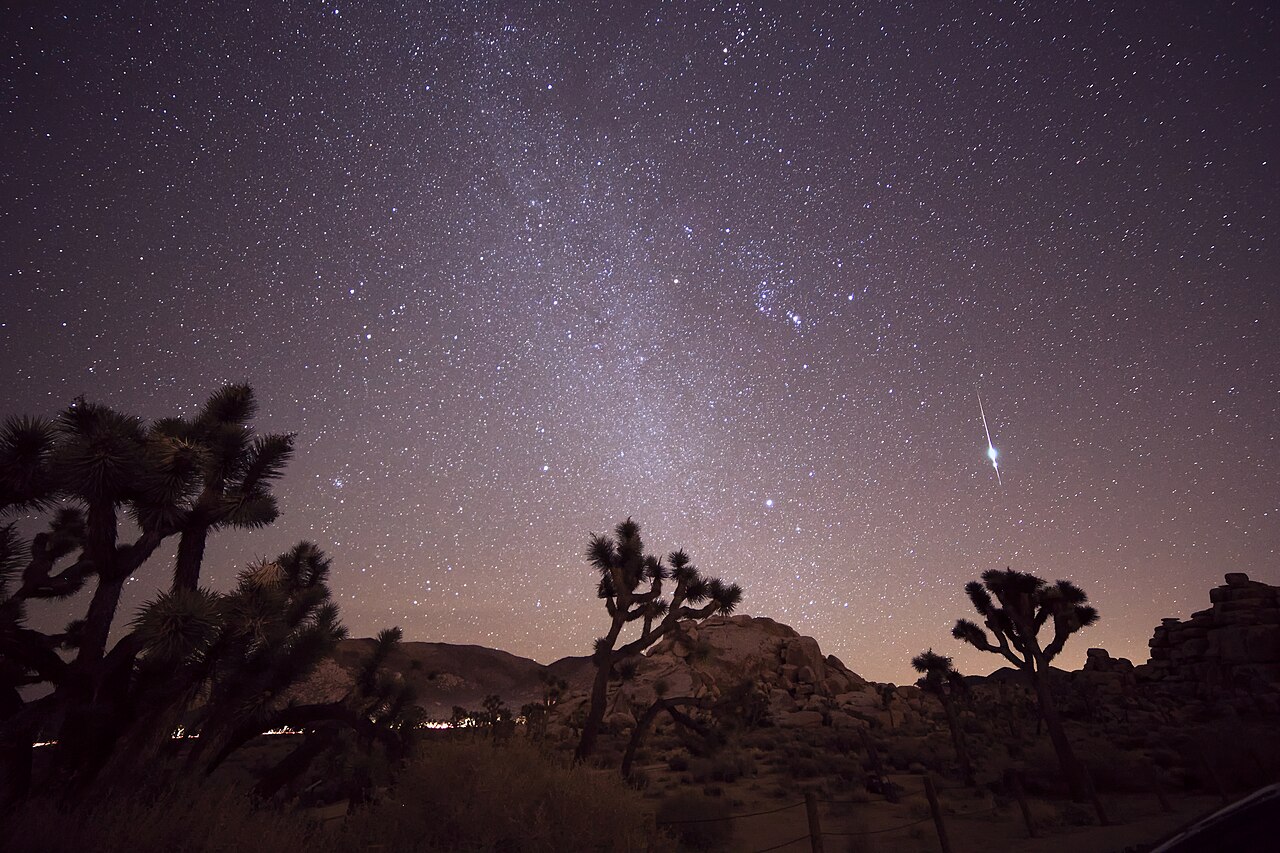
The photograph here is documented as a November 6, 2015 Taurid image from Joshua Tree, California, with a 30-second exposure. It records a past scene under the photographer's conditions. Its appearance should not be treated as a forecast for your sky, a live report from this Halloween or a direct reproduction of what your eyes will see.
This explanation uses published observing guidance and calendar entries. No local sky survey or new sighting is claimed, and the differing Southern peak dates remain a limitation. The point of the guide is to set an honest observing expectation, not to guarantee a result.
Historical photo credit
Taurid Meteor Shower - Joshua Tree, California - 6 Nov. 2015, by Channone Arif, via Wikimedia Commons, used under CC BY 2.0. The provider resized the photograph; display cropping may apply. No local pixel edits were made and no endorsement is implied. The source records a 30-second exposure; this is historical context.
FOLLOW THE TRAIL
Sources & further reading
- Royal Observatory Greenwich — Taurid meteor shower ↗
Primary observatory guidance: nickname, stream explanation, observing technique and 2026 calendar entries. Its Southern peak differs from AMS.
- American Meteor Society — 2026/2027 meteor shower calendar ↗
Primary meteor-observer organization: separate Taurid branches, activity windows and Northern November 11–12 peak night; Southern components are distinguished.
Prepared with AI assistance from observatory and meteor-society guidance. Southern Taurid peak dates differ between the read calendars and have not been independently resolved. No 2026 sighting, local weather forecast or unusual-outburst prediction is claimed. The licensed photograph is a historical long exposure from 2015. Read our editorial policy.
Last updated . Suggest a correction ↗