AT A GLANCE
- The study describes a rock that formed at least 4.1 billion years ago; that is not the date it reached Earth.
- Found in Mali in 2022, Teghaza 001 preserves evidence of ancient Martian crust and reactions with fluids before ejection.
- The sample also has alteration formed on Earth, so not every changed mineral should be presented as evidence of Martian water.
A meteorite called Teghaza 001 is offering a window into ancient Mars. The original study abstract registered with Crossref describes a slowly cooled igneous rock that formed at least 4.1 billion years ago. The number concerns the rock's geological history, rather than the day it landed on Earth or the moment somebody picked it up. That distinction is the key to understanding the new research.
One rock, several different dates
The October 29 research announcement places its discovery in Mali's Sahara Desert in 2022. The Science paper was published on October 29, 2026. Discovery, analysis and publication therefore belong at different points on the timeline; a newly reported result does not mean the specimen was found this week.
The abstract's wording also matters: at least gives a lower age boundary. It should not be turned into an exact birthday. Nor does the formation age supply a date for the later impact that expelled the material from Mars. Those are separate events requiring their own evidence.
Why is this particular sample useful?
The study abstract identifies an ancient crustal sample with composition, minerals and texture distinct from other Martian meteorites. Its authors connect it to a geochemically distinct mantle source. They also report minerals altered by water and oxygen-isotope measurements indicating reactions with oxygen-18-enriched fluids before the rock was ejected into space.
A useful way to read this finding is to separate the rock's origin from changes that happened afterward. A sample can preserve information about both without either history cancelling the other. Evidence for fluid reactions is also narrower than a claim that this specimen proves an inhabited planet; the accessible abstract reports no such result.
Does every altered mineral point to Mars?
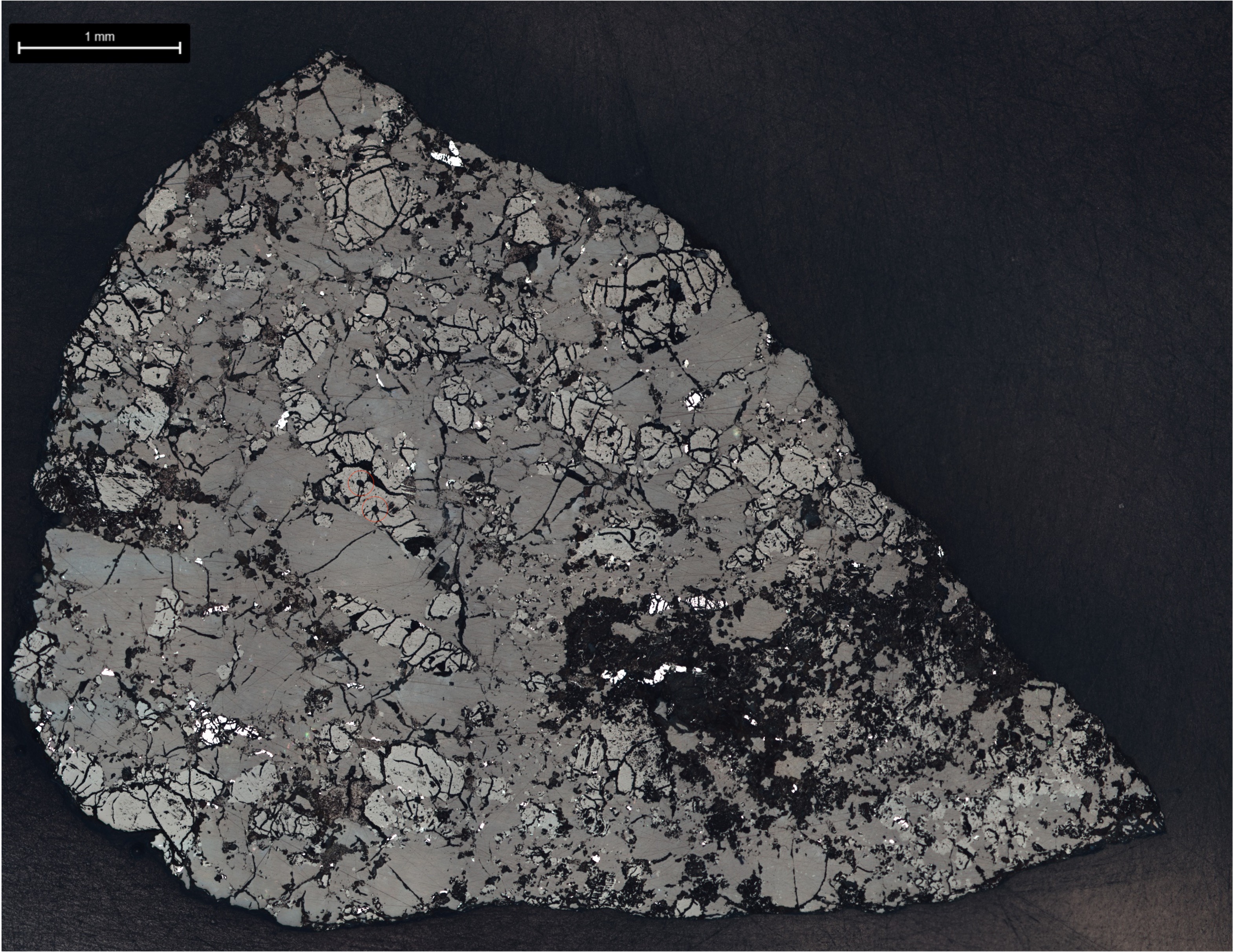
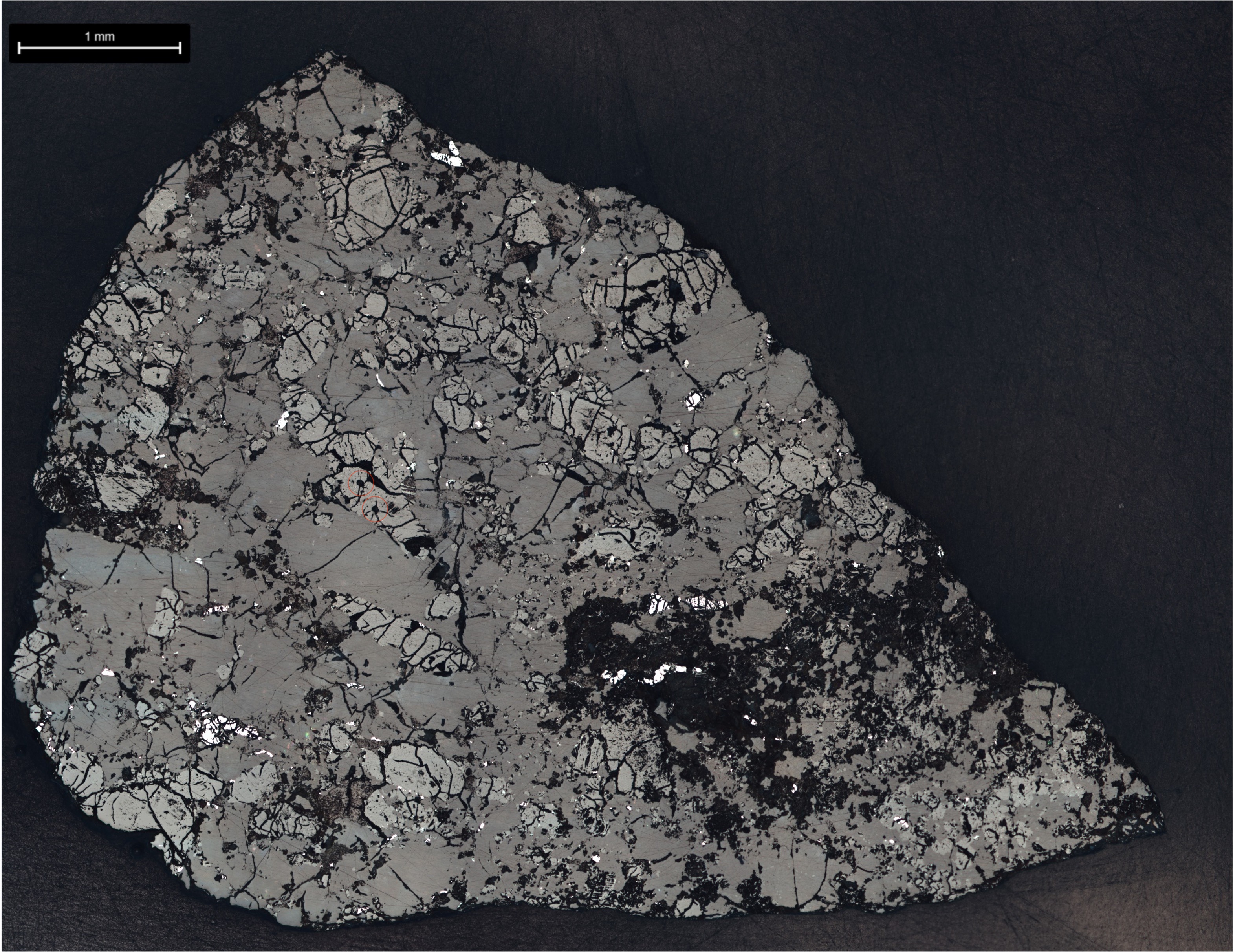
No. The official sample-image description explains that reflected-light imaging helps researchers locate minerals for analysis. Its annotated companion identifies iron-titanium oxides, pyroxene and impact-shocked plagioclase. It separately identifies fine-grained carbonate, sulfate and clay alteration formed on Earth.
That is not a contradiction of ancient Martian fluid reactions. It is a reminder to ask which feature is being discussed and when it formed. A photograph can show a complicated mineral mosaic without independently dating every part of it. The accompanying scientific interpretation is what assigns different pieces of evidence to different stages of the sample's history.
What remains uncertain?
The research announcement describes several possible source locations matching the sample, rather than one established launch site on Mars. It also distinguishes the October study from a separate June paper on water content. This guide uses the announcement, registered abstract and sample-image explanation; the full Science article returned an access restriction. It does not claim a full-paper review, independent laboratory measurements or a precise ejection date.
Image source and reuse
Slice of Martian Meteorite Teghaza 001, PIA26801, courtesy NASA/JPL-Caltech. Open the complete original JPEG for the full sample and scale bar. Used for factual science reporting under the NASA media usage guidelines. The downloaded file is unchanged; the site may crop its display. This publication is not endorsed or reviewed by NASA, JPL or Caltech.
FOLLOW THE TRAIL
Sources & further reading
- Science study — publisher-deposited Crossref abstract ↗
Primary abstract and October 29 publication metadata: minimum formation age, ancient crust, mineral and isotope evidence. Full paper was inaccessible.
- NASA/JPL — October 29 research announcement ↗
Primary research-team announcement: 2022 discovery, geological context, separate June paper and uncertain exact source location.
- NASA Photojournal — sample slice PIA26801 ↗
Primary specimen-image explanation, analytical purpose and distinction between impact features and alteration formed on Earth.
Prepared with AI assistance from a research-team announcement, the publisher-deposited study abstract and the official sample-image description. The full Science article was inaccessible. No sample examination, laboratory replication or independent origin determination is claimed. The image is an actual specimen slice, not an AI-generated illustration; its source organizations have not reviewed this article. Read our editorial policy.
Last updated . Suggest a correction ↗