AT A GLANCE
- Rubin announced 2026 ED138 on October 27; it remains a dwarf planet candidate.
- The preliminary diameter estimate spans roughly 600–1,500 kilometres.
- Discovering an object and establishing its physical classification are separate steps.
Dwarf planet and Pluto appeared in our Australian and German Google Trends samples following Rubin Observatory's October 27 announcement of 2026 ED138. The important word is candidate. A newly identified object can be real while its size and classification still need further work. The announcement does not by itself add another confirmed planet to a textbook list.
What has Rubin found?
The observatory reports an object beyond Neptune, currently about 46 astronomical units from the Sun. Its estimated diameter is 600–1,500 kilometres, depending on assumptions including surface reflectivity. Infrared observations are needed to narrow its size and clarify its nature.
A range that wide should remain a range. Choosing its largest endpoint for a headline would make an uncertain estimate sound like a measurement. Nor does brightness alone provide a picture of the object's surface. Keep the detection, estimated dimensions and interpretation distinct when comparing coverage.
What makes something a dwarf planet?
NASA's explanation of the IAU definition describes a dwarf planet as a body orbiting the Sun, with enough self-gravity to become nearly round, which has not cleared its orbital neighbourhood and is not a satellite. Roundness is therefore part of the classification, alongside the object's orbital circumstances.
This is more specific than calling any small, distant object a dwarf planet. A discovery can establish that something moves through the solar system without settling every physical requirement. NASA also explains that the 2006 classification placed Pluto in the dwarf-planet category. A fresh candidate does not reverse that definition; it gives researchers another object to assess against it.
Why do the observations predate the announcement?
According to the discovery account, Matthew Holman identified the object while analysing earlier Rubin data on October 13. The team then linked more observations, including archival images reaching back to 2016. The public announcement followed on October 27.
That sequence explains how a newly announced discovery can have a much longer observational history. An image can contain an unnoticed object before researchers connect it with observations from other dates. The announcement date, recognition of the object and dates when its light was recorded answer different questions.
What does the published image show?
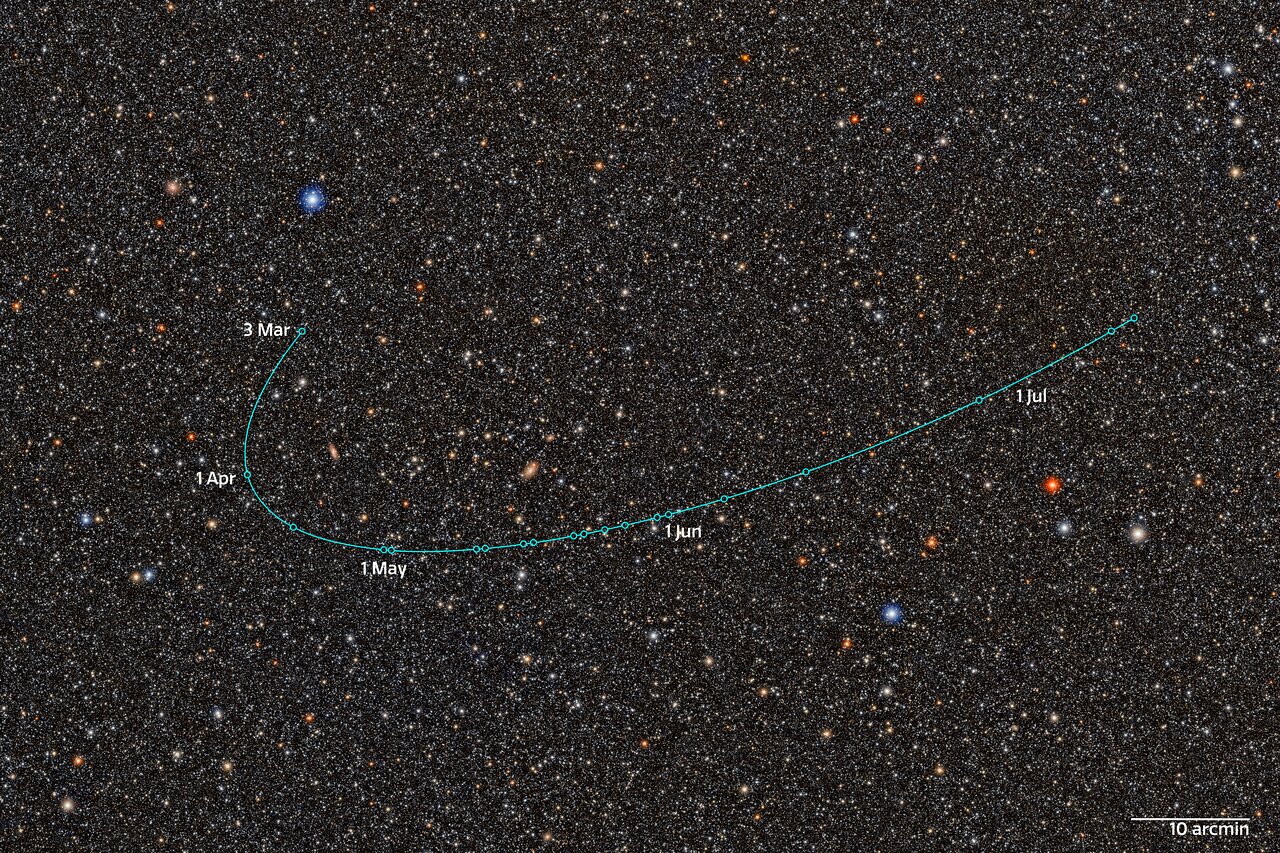
The NOIRLab image page identifies the accompanying star field as a composite of observations from March through July 2026. Teal circles mark the object's positions in the constituent images. It is an annotated observational product, rather than a single exposure showing a continuous glowing trail.
It also cannot tell readers what mountains, ice patterns or other surface features look like. When following future updates, look for what was actually measured and whether the classification changed, rather than treating a more dramatic illustration as new physical evidence. This article reports the published preliminary result; it does not independently calculate an orbit or diameter.
Image credit and reuse
2026 ED138 orbital arc (with annotations): NSF–DOE Vera C. Rubin Observatory/NOIRLab/SLAC/AURA. Image processing: M. Jurić (UW), D. de Martin & M. Zamani (NSF NOIRLab). Used under CC BY 4.0 and the NOIRLab usage policy. The provider's screensize JPEG retains the source annotations; the site may crop its display. No endorsement is implied.
FOLLOW THE TRAIL
Sources & further reading
- Rubin Observatory — First dwarf planet candidate ↗
October 27 primary discovery announcement, preliminary dimensions and archival-observation timeline.
- NASA — What is a planet? ↗
IAU classification criteria, including the distinct dwarf-planet definition.
- NOIRLab — Annotated 2026 ED138 observational composite ↗
Explains what the multi-date composite and position markers represent; image credits and reuse-policy link.
Prepared with AI assistance from the linked discovery announcement, NASA explanation and image documentation. No independent analysis of telescope data, orbit fitting or size measurement is claimed. The candidate classification and estimated diameter remain preliminary. Read our editorial policy.
Last updated . Suggest a correction ↗