AT A GLANCE
- Nintendo’s UK interview introduces the Switch 2 remake with a November 5 launch date.
- Aonuma says extra warp points were tried and removed because they reduced discoveries along the route.
- The sound discussion includes environmental detail and microphone recognition for ocarina songs; these are developer accounts, not our playtest results.
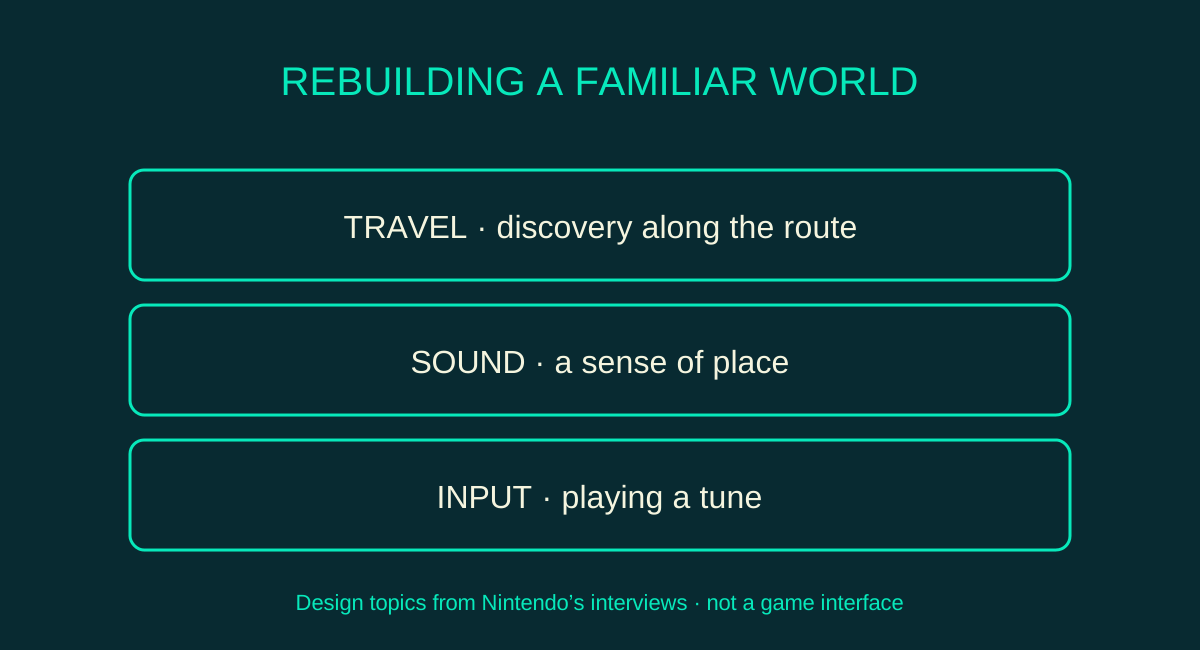
Ocarina of Time on Nintendo Switch 2 is approaching its November 5 launch, and Nintendo’s developer interviews explain why rebuilding a familiar game involves more than sharper images. Chapter 1, published November 2, describes a travel shortcut that was tried and rejected. Chapter 4, published November 3, turns to sound and interaction. Together, they offer a useful way to read remake announcements: ask which experiences a change preserves, and which experiences it might remove.
Why adding a shortcut did not solve the travel problem
Producer Eiji Aonuma says he proposed additional warp points to make travel quicker. After trying them, he felt that players were missing opportunities to stop and discover things along the way. The team removed those added points. This is an account of a development decision; it should not be expanded into a claim that the finished game has no fast travel of any kind.
The interesting tradeoff is between reaching a destination and noticing the route. A shortcut can reduce repetition while also bypassing an encounter that makes a place memorable. Faster movement is therefore not automatically the same as a better exploration experience. Nintendo’s example is useful because it describes a change being reconsidered after play, rather than treating every added convenience as an unquestioned improvement.
Sound can change how a place feels
In Chapter 4, Ohashi discusses environmental details such as wind in leaves, flowing water and wildlife. The team describes a waterfall becoming quieter as the player moves away. The interview also says the game supports 5.1-channel surround sound.
These examples point to a different kind of remake detail from a character model or texture. Sound can communicate position and distance, and help distinguish an environment that merely looks elaborate from one that seems inhabited. That is our interpretation of the design discussion, rather than a finding from listening to the finished game. We have not compared audio equipment or measured spatial effects.
The microphone idea adds another way to interact
The developers also describe using Switch 2’s built-in microphone to recognise a song hummed by the player, with Link then playing it on the ocarina. Aonuma says the feature is not simply a way to make progression easier. Its appeal, as presented in the interview, is a more immediate interaction with the world.
A feature description and a reliability test answer different questions. The account establishes what the developers say they designed. It does not tell us how recognition performs for every voice, room or background-noise condition. Treat microphone support as a specific interaction to investigate, not proof that every player will have an identical experience.
Read the interviews as design evidence
Both pages come from Nintendo and are translated developer interviews. They provide first-hand explanations of intentions and decisions, while also serving the publisher’s presentation of its game. They are not independent reviews.
For a returning player, the useful comparison is between remembered activities and the new ways of presenting them: travelling, listening and playing a tune. For a newcomer, those same activities explain the kind of experience the developers are discussing without requiring a verdict about whether the remake is better. This guide does not rate performance, supply a review score or claim hands-on play.
FOLLOW THE TRAIL
Sources & further reading
- Nintendo — Ask the Developer Vol. 24, Chapter 1 ↗
Primary interview dated November 2: launch context and the trial/removal of additional warp points.
- Nintendo — Ask the Developer Vol. 24, Chapter 4 ↗
Primary interview dated November 3: ambient audio, surround support and microphone interaction.
Prepared with AI assistance from two Nintendo interview pages read November 4, 2026. Developer statements are attributed to Nintendo. No gameplay, microphone recognition, audio hardware or performance testing was performed. The diagram is original explanatory artwork. Read our editorial policy.
Last updated . Suggest a correction ↗