AT A GLANCE
- A light-day measures distance: how far light travels in 24 hours, not how long Voyager took to get there.
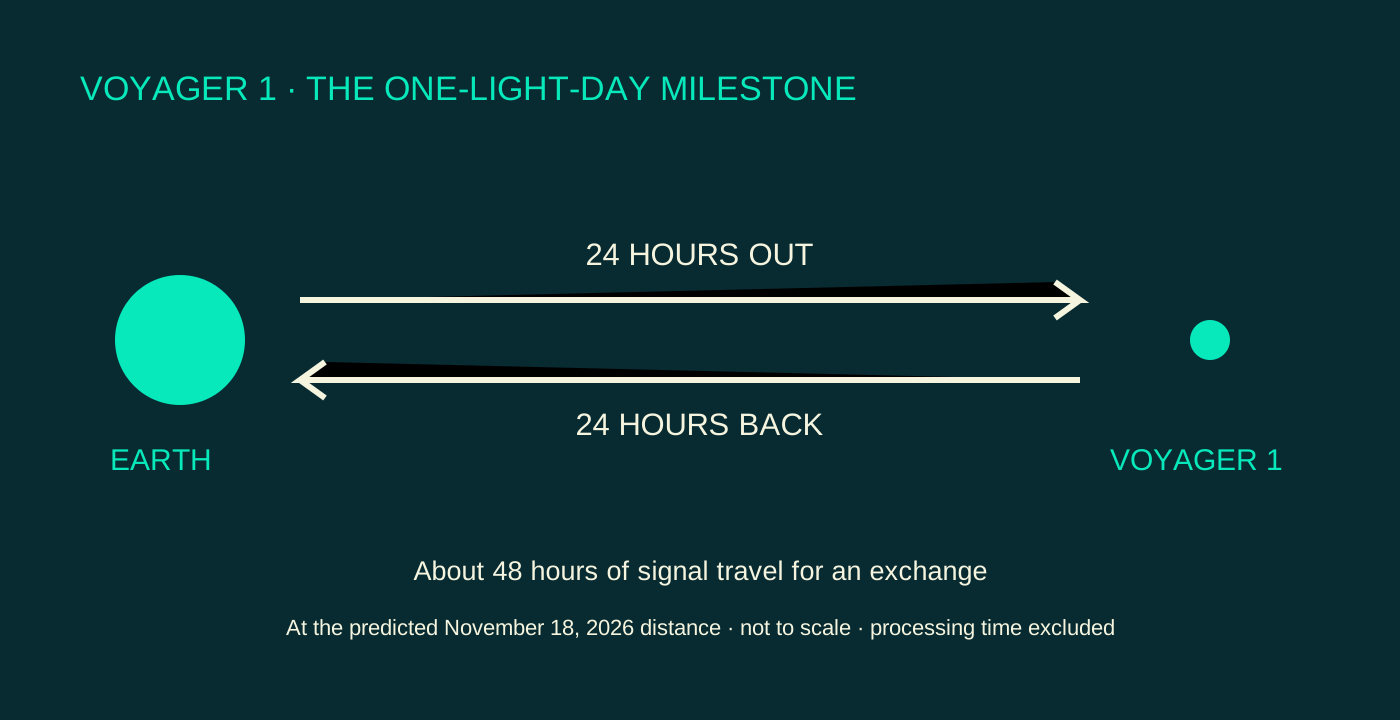
- At that distance, an outward command and a return signal require about 48 hours of travel altogether.
- NASA reported restored contact on October 20; its October 29 update still described an investigation into the cause.
Voyager 1 is approaching a distance that changes how an ordinary word such as conversation should be understood. NASA’s light-day guide puts the spacecraft’s one-light-day milestone on November 18, 2026. A radio message will then need 24 hours to reach it. A return message needs another 24 hours to cross the distance back. The date marks an extraordinary separation from Earth, rather than a new destination that the spacecraft can land on.
A distance unit with a familiar time in its name
A light-day is the distance light travels in 24 hours, roughly 26 billion kilometres. NASA explains that radio waves and visible light both belong to electromagnetic radiation, so the same light-travel reasoning applies to spacecraft communications.
The useful comparison is between the traveller and the message. Voyager has spent nearly 50 years on its journey; a signal covers the relevant Earth-spacecraft separation in a day at the milestone. These are different measures. The phrase does not mean the probe is moving at light speed, or that its whole trip lasted 24 hours.
Why a command and reply take longer than one day
Add the two paths together: 24 hours outward plus 24 hours back gives about 48 hours of signal travel. This is a simplified calculation at the stated distance, excluding the time needed to process a command or arrange communications.
An apparent wait therefore needs a carefully defined starting point. Has a command just left Earth, has it arrived at the spacecraft, or is a response already on its way home? Those stages cannot be treated as simultaneous. A two-way exchange involves two separate journeys even when the reply is brief.
The October contact interruption had already ended
In its October 29 mission update, NASA reported that the Deep Space Network did not detect Voyager 1 during scheduled contacts on October 18 and 19. The signal returned on October 20, and the agency said contact had continued since then. This was an account of an earlier interruption, not confirmation that the spacecraft was still silent when this explainer was prepared.
NASA said engineers were investigating the cause. They had determined that a thruster group went offline and backup thrusters activated through automatic fault protection. Identifying that response is different from establishing every step that caused it. The update also discussed conserving power as the spacecraft ages; it did not declare the mission finished.
What November 18 will change—and what it will not
NASA says crossing the one-light-day distance will not itself change the spacecraft or its surroundings. It is a milestone in scale and endurance. That makes it useful for understanding communication delays, without turning a measurement threshold into a physical boundary in space.
Keep the source date attached to operational claims. A reported recovery, an investigation and a predicted distance milestone are three different kinds of information. None of them alone guarantees future contact or establishes how long every later command sequence will take. This guide explains their relationship using NASA’s published account, rather than a live telemetry check.
FOLLOW THE TRAIL
Sources & further reading
- NASA — What Is a Light-Day? ↗
Primary explanation of distance, electromagnetic signals and predicted November 18 Earth-relative milestone.
- NASA — Voyager 1 conserves power and resolves communications pause ↗
October 29 primary status report: October 18–19 missed contacts, October 20 recovery and continuing investigation.
Prepared with AI assistance from two NASA pages read November 3, 2026. The signal-time example is arithmetic, not an operational test. No live telemetry was inspected. The diagram is an original schematic, not to scale. Read our editorial policy.
Last updated . Suggest a correction ↗