AT A GLANCE
- Sungei Bedok, Bedok South and Xilin are scheduled to open for passenger service on December 26, 2026.
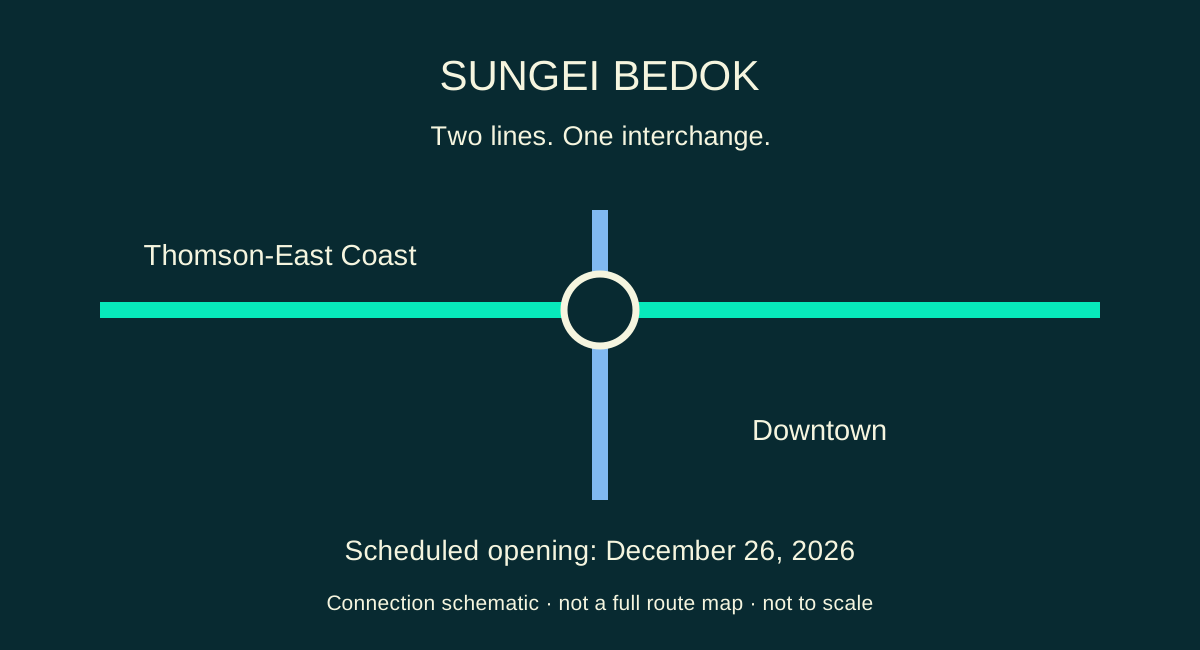
- Sungei Bedok connects the Thomson-East Coast Line and Downtown Line, allowing a change between them.
- The published 25-minute saving is a specific journey example, not a promise for every passenger.
Sungei Bedok MRT is scheduled to open on December 26, 2026, as an interchange between Singapore’s Thomson-East Coast Line and Downtown Line. The Land Transport Authority announcement also names Bedok South and Xilin as new stations opening that day. For a visitor, the useful change is the connection between two lines: a journey that uses both can be planned around a transfer in the east. The opening remains a future service date, rather than a route available to ride today.
Three stations, with one shared interchange
The station codes help separate the pieces. Bedok South is TE30, Xilin is DT36, and Sungei Bedok carries both TE31 and DT37. LTA groups the work as Thomson-East Coast Line Stage 5 and the Downtown Line 3 Extension. Together, the extensions cover 4.3 kilometres.
CNA’s report describes Sungei Bedok as an underground interchange and the second connection between the two lines after Stevens. It says Bedok South serves nearby residents and schools along Upper East Coast Road, while Xilin improves access to the Changi South industrial estate and Changi Business Park.
What a 25-minute saving actually compares
LTA gives the example of Havelock to Changi Business Park: around 45 minutes using the two lines, compared with 70 minutes today. The difference is up to 25 minutes for that example. CNA reports the same comparison and a separate saving of up to 10 minutes between Marine Parade and Tampines.
Those figures are useful starting points, but a travel-time headline needs its endpoints attached. Changing the starting station, destination or connecting leg changes the journey being compared. Do not subtract 25 minutes from an unrelated trip simply because it passes through the new interchange. Compare the complete route you intend to take.
A connection is different from a direct service
An interchange lets a passenger move from one line to another. It does not mean that every destination mentioned near the announcement is reached on one train. Read the station pair and any change of line together when comparing alternatives.
For an overseas visitor choosing accommodation or arranging an outing, keep the travel date beside the route. A future map can be informative while still being unsuitable for a journey before the service begins. The same station name can appear in construction news, opening announcements and operational directions, each answering a different question.
Check the operating details near your travel date
Before travelling, confirm that the opening schedule still applies and use current operator information for service hours, fares and any disruption. This article does not establish first-train times, walking routes inside the interchange or a particular fare. Those details should come from the information for the actual journey.
The sources were read on November 4. We have not ridden the new sections or measured transfer times. Treat the agency’s examples as published planning information, and the diagram as a simple explanation of the line connection.
FOLLOW THE TRAIL
Sources & further reading
- LTA — TEL5 and DTL3 Extension opening announcement ↗
Primary release dated November 4: opening date, station codes, interchange and travel-time examples.
- CNA — Bedok South, Xilin and Sungei Bedok opening ↗
Reporting on the opening, station locations, interchange and journey comparisons.
Prepared with AI assistance from two source pages read November 4, 2026. Opening and travel-time information is attributed to LTA and CNA. No ride, transfer-time measurement or fare check was performed. The schematic is original and not to scale. Read our editorial policy.
Last updated . Suggest a correction ↗